Footwear TRACISCORE
The footwear industry’s data architecture standard for shoe traceability at the product level
- Directs the footwear industry on which materials and components need to be mapped across all supplier tiers.
- Establishes a clear scoring system for the entire industry to unify efforts in complying with EU DPP regulations.
- Provides a comprehensive operations roadmap for traceability programs, including how to prioritize areas tied to regulatory
compliance, in a way that will help clearly communicate what we need suppliers to provide. - Developed by industry leaders and experts to align efforts to ensure industry success.
- Informs policymakers on unique shoe traceabilty challenges, with standards they can adopt.
- Published by FDRA, the footwear industry's association, as the industry's standard.
Tool published September 2024. The tool will update in 2026 complete with all shoe component areas. Companies can begin their work now on Phase 1 areas.
Footwear is more like a Tesla than a T-shirt.
It's why this tool was created.

THE PROBLEM: traceability standards throwing shoes in with apparel
- Shoes have 10x more materials than clothes/'textiles'.
- Shoes have 30+ materials not seen in 'textiles' including steel and foams.
- Shoe supply chains are unique and vast, in part due to the variety of materials that must be used to produce a product that must perform on feet every step.
- Yet, the push for erroneous one-sized fits all "fashion/textile" standards continues from retailers to organizations to governments.
- Wrong assumptions that standards made for clothing can just apply to shoes must end—they cannot succeed.
- Consider this: airplanes and trains are both in the transportation industry—should their standards be the same?
WHAT WORKS: individual right-sized standards for each "fashion" product – hence this tool for footwear specifically.
- There are clear and vital differences between shoes and shirt materials and supply chains.
- Once this is realized, the only way forward is right-sized traceability standards, policy, and programs by each product type.
- One for clothing. One for shoes. One for Handbags. One for accessories.
- Some targets may be shared, but differences must be accounted for and unique scopes must be made.
- Real success requires multiple policy tracks and standards that fit each individual "fashion" product, like shoes. AND different timelines for implementations - recognising that it may take a year or more longer than apperal for footwear traceability compliance.
Features of the Tool

Roadmap to tracing down to raw material creation
- Provides an operational guide stepping through a supply chain, mapping suppliers and materials.
- Identifies gaps to target and critical areas to focus efforts.

Organized and meticulous data input system by material and shoe area
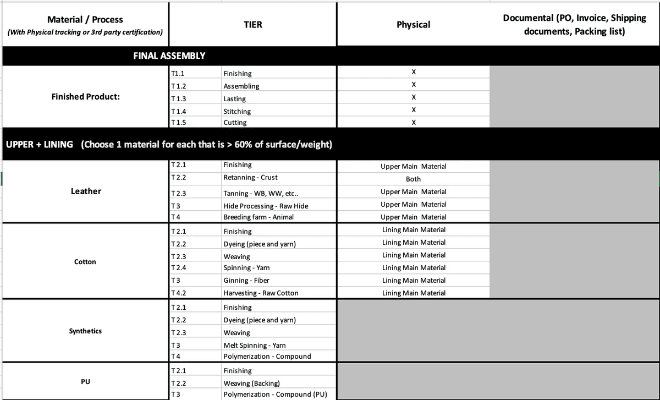
- Segments shoe into upper, lining, outsole and insole, and inquires their material types.
- Inquires on process: tanning, dyeing, weaving, polymerization, harvesting, etc.

Scoring percents based on traceability tier depth and type of verification
- Assigns scores based on key areas and depth of traceability.
- Greater percents provided to physical vs. documented traceability, and further toward T4.
Deeper Background on TRACISCORE
Why does the footwear industry need this tool?
- Traceability mandates in the footwear industry are expanding rapidly. Laws now include the USFPLA and EU deforestation (EUDR), even as additional regulations are emerging from Europe regarding consumer-facing traceability information at the product level via a Digital Product Passport (DPP).
- The challenge for footwear is multifaceted and significantly more complex than for apparel or other 'textile' goods:
- Footwear companies must trace over 60 different materials and components across multiple suppliers located on different continents, varying with each season.
- Each season may introduce new shoe designs, meaning this exercise could involve over 100 product types annually for some companies.
- An internal compliance system for shoe traceability must be both robust and agile, with supplier data collection expected to be underway, with another 3 or more years required to be ready for consumer reporting.
- With hundreds of data points per shoe, how will consumers fully understand the information communicated to them as required by DPP law?
Who developed this tool?
- In 2023, a group of 15 companies met virtually to discuss these growing regulatory challenges, especially the DPP, which will change how traceability is communicated directly to consumers.
- The group agreed to develop a tool that would standardize industry efforts and align everyone on the following path towards traceability:
- Identify the material areas (main/majority) in footwear we must trace.
- Set a realistic path to trace from Tier 1 down to T4.
- Set majority material/weight considerations.
- Set the level of traceability – physical versus documentation.
- Create a scoring system that would provide companies a look at how well-traced each product was, helping operationalize traceability strategy.
- Create a color-coding system the industry can align on for consumers.
Why should policymakers study this tool for adoption?
- FDRA encourages policymakers to review this tool to track the footwear industry's progress in our approach to transparency.
- To understand why creating traceability systems at the product level will take several years. We project that by 2030, companies will be able to publicly report robust and accurate programs.
- To adopt this tool as the legal standard in Europe and beyond for global policy standardization.
What are the principals of this tool?
- Sole focus: traceability.
- Open source and free.
- Easy-to-use tool built in Excel that can be fed into any software or system a company uses.
- Creates a consistent industry-wide scoring system that can be used to measure internal progress and gaps, helping companies measure against an industry average.
- Establishes one consistent scoring to color-coding system for shoe traceability that consumers can understand.
What are next steps to finalize this tool?
- September 2024: After industry feedback, Phase 1 of this tool is complete. Companies can begin to utilize it for upper + lining materials for a shoe.
- Spring 2025: Move into Phase 2, adding outsole and insock, along with finalizing scoring and color code for the entire shoe.
Shoe Supplier Tiers Defined
Shoe Supplier Tiers Defined:
- TIER 1 SUPPLIERS: take processed materials and components and assemble a final shoe, package and send them to the footwear brand/retailer.
- TIER 2 SUPPLIERS: develop refined raw materials into processed components going into Tier 1 final assembly: like the rubber soles, molded foams, fabric uppers, or insoles that are used to create the finished shoe.
- TIER 3 SUPPLIERS: prepare / refine raw materials for Tier 2: like slaughterhouses/tanneries, chemical processing plants into synthetics/plastics, textile mills/yarn spinners/cotton gins, rubber vulcanizer, pelletized EVA, etc.
- TIER 4 SUPPLIERS: farms, mines, and/or labs that provide raw materials. Examples: farming cotton, farms extracting rubber from trees, cattle farm, metal / mineral mines, or oil extraction company.
© 2026 FDRA